Guide
Spikes after breakfast, lunch or dinner
Which meal time is the hardest, from your own CGM readings, weekdays apart from weekends.
The short answer
Take the same three clock hours from every day, for example 7 to 10 am for breakfast, and stack them. Draw the middle reading for each 10 minutes, the middle half around it, and the 5th to 95th percentile outside that. The wider and higher the band after the meal, the harder that meal time is. The 2019 consensus draws a whole day the same way, as a glucose profile.
Count every day, logged meal or not. A day you skipped breakfast or forgot to log it still tells you what that time of day does.
In Glide: My Lab, by time of day
| Meal time | Clock hours |
|---|---|
| Breakfast | 7 am – 10 am |
| Lunch | 12 pm – 3 pm |
| Dinner | 6 pm – 9 pm |
Each one twice, weekdays and weekends. Glide reads these from the pump, so it needs a Tandem pump or a pump that uploads to Glooko connected (beta), with the carbs entered in the pump's bolus calculator. Carbs outside the three windows are left out.
Every day with pump carbs in a window gets one row, with two numbers:
- Carb ratio: all the carbs entered in the pump in that window, divided by all the insulin bolused by hand in it, in grams per unit. Insulin the pump gives on its own (Control-IQ) does not count. A juice box for a low counts as carbs.
- Time in range over the same window, the same span the row's curve shows.
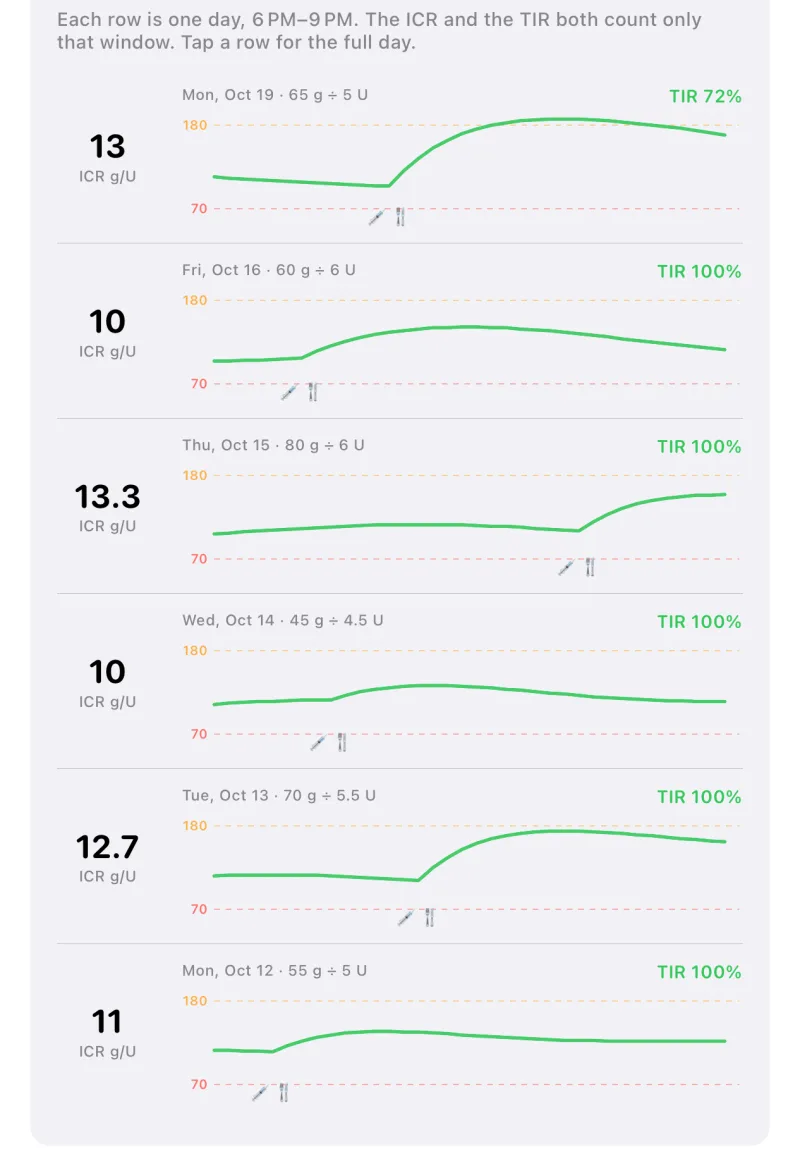
Each meal time's card shows the middle carb ratio of its days and the time in range of all their readings together. It shows the carb ratio that was used, not the one to use. Dosing decisions stay with you and your care team.
The time in range stops where the window stops. A dinner at 8:30 pm that peaks at 10 pm counts only its first half hour, so a late meal can read better than it went.
What to compare it with
- The ADA Standards of Care list a peak after meals below 180 mg/dL (10.0 mmol/L) as a goal for many adults with diabetes. If the middle line crosses it most days, that meal time spikes more often than not.
- Breakfast often runs higher than other meals with the same food. One reason is the dawn phenomenon, a rise toward the end of the night with no food and no low before it.
- Weekends move meals by an hour or two. A weekend breakfast at 11 am is outside the 7 am – 10 am window, so it is not in the breakfast numbers at all.